
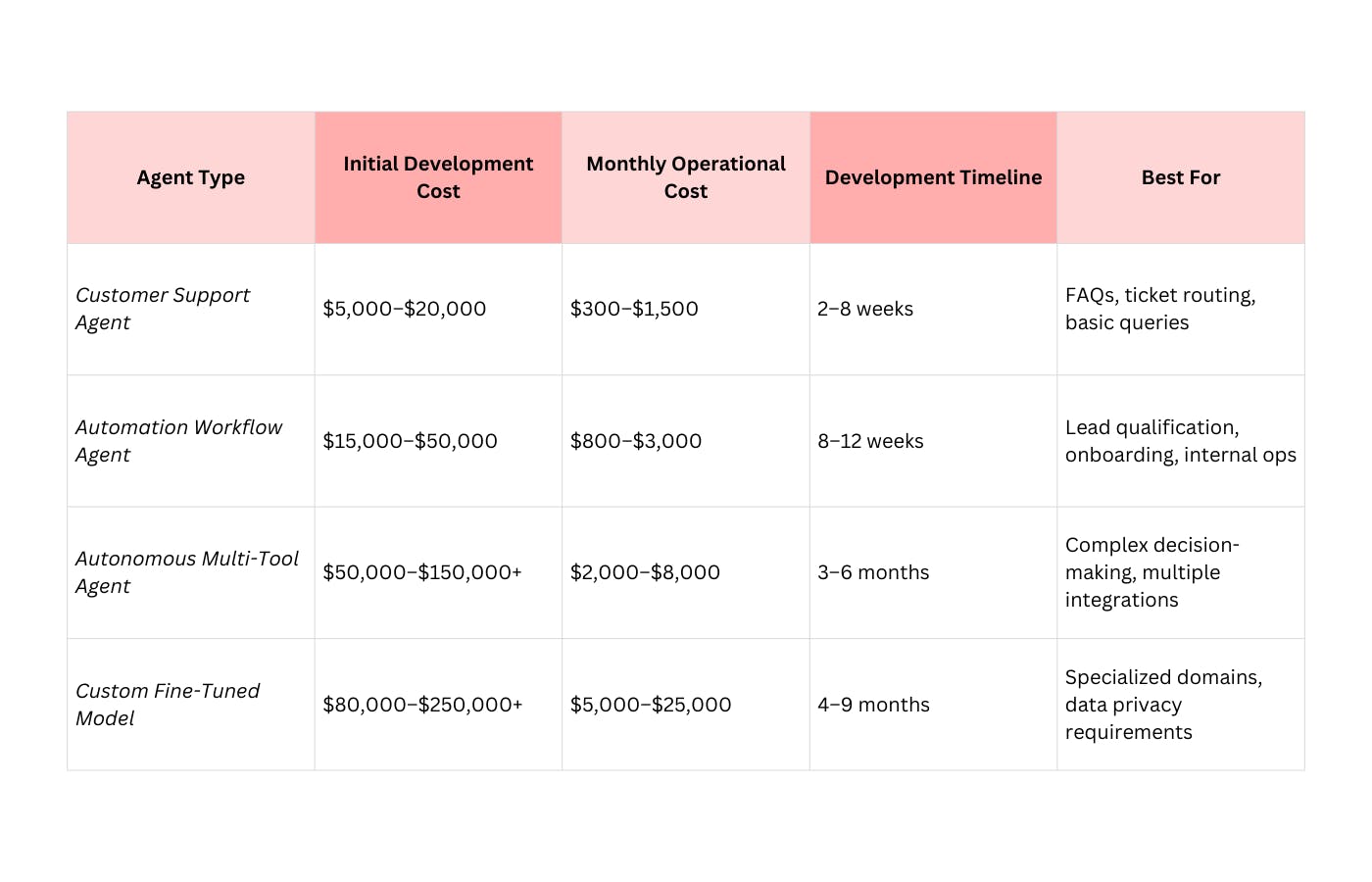
The AI agent development cost in 2025 can range from $5,000 to over $150,000 depending on the complexity and functionality of the solution. Basic customer support chatbots typically start at $5,000 to $20,000. Mid-level automation agents, designed to handle more sophisticated tasks, usually cost between $15,000 and $50,000. Advanced enterprise AI agents capable of integrating multiple tools and workflows can exceed $50,000 to $150,000.
The AI agent market is booming. Valued at $7.63 billion in 2025, it is projected to reach $182.97 billion by 2033, growing at nearly 50 percent annually. While this rapid expansion presents enormous opportunities, it also makes estimating AI agent development cost confusing for many businesses.
The Challenge: Businesses often struggle to budget accurately because AI agent pricing depends on numerous factors, including model selection, integrations, infrastructure, and data preparation.
The Solution: This guide provides a clear breakdown of AI agent development cost, highlighting pricing tiers, cost drivers, and actionable strategies. By understanding these factors, you can plan your AI project with confidence and avoid unexpected budget surprises.
Key Takeaways
- Cost ranges by agent type: AI agent development cost varies by complexity—basic customer support agents start at $5,000–$20,000, workflow automation agents $15,000–$50,000, autonomous multi-tool agents $50,000–$150,000+, and custom fine-tuned models $80,000–$250,000+.
- Key cost factors: Agent type, model selection, integrations, prompt engineering, data preparation (often 40-60% of total costs), infrastructure, and compliance drive AI agent pricing - understanding these helps optimize budgets.
- Optimization strategies: Use MVP approaches, pre-trained models, no-code platforms, agency partnerships like BinarCode’s AI services, and scalability planning to reduce costs by 30-50%.
Looking to optimize your AI agent development cost?
Build tailored AI agents with BinarCode that meet your unique business needs without overspending.
Cost Breakdown by Type of AI Agent
Understanding AI agent development cost breakdown is crucial as costs vary based on complexity, capabilities, and integrations. Factors like processing sophistication, integration depth, and autonomy level determine pricing tiers. Here are precise ranges to help you organise your budget.
Price of Customer Support AI Agent
Cost Range: $5,000–$20,000 initial development + $300–$1,500/month operational costs
These basic agents handle simple interactions via chatbot logic and minimal integrations. They focus on FAQs, ticket routing, and information retrieval.
Typical features:
- Template responses
- Knowledge base access
- Sentiment detection
- Chat handoff
- Basic CRM links
Real-world examples: BinarCode developed an AI-powered assistant for Growee.ai, an HR management platform. The AI agent accesses relevant company and employee data to provide instant answers to HR-related questions, helping managers create job postings, check team member information, find upcoming leaves, and get advice on workplace situations. The implementation streamlined HR operations while maintaining strict data privacy, all conversations remain private and no data is shared with third-party systems beyond the necessary AI processing.
Automation Workflow Agent
Cost Range: $15,000–$50,000 initial development + $800–$3,000/month operational costs
Mid-level agents manage processes like lead qualification and onboarding with conditional logic and moderate integrations.
Capabilities:
- Lead scoring
- Multi-channel sequences
- Data extraction
- Workflow approvals
- CRM/marketing tool links
Real-world examples: An e-commerce site automates lead follow-ups and Salesforce updates. In marketing, it handles campaign personalization, boosting engagement by 40%.
Projects span 8-12 weeks, with focus on workflow mapping and testing.
Autonomous Multi-Tool AI Agent
Cost Range: $50,000–$150,000+ initial development + $2,000–$8,000/month operational costs
Advanced agents feature decision-making, memory, and API orchestration for complex tasks.
Features:
- Tool selection
- Context retention
- Multi-step reasoning
- API management
- Adaptive learning
Real-world examples: A logistics company monitors supply chains and optimizes routes. In healthcare, it analyzes patient data and suggests treatments, ensuring compliance.
Timelines are 3-6 months due to rigorous training and validation.
Custom Fine-Tuned AI Model
Cost Range: $80,000–$250,000+ for training and development + $5,000–$25,000/month for serving
These involve proprietary training for unique needs, including custom data and architecture.
Requirements:
- Data collection
- Model design
- Compute setup
- Validation
- Maintenance
Real-world examples: A manufacturing firm trains models for predictive maintenance. In pharma, it’s used for drug discovery simulations.
What Affects the Cost of Building an AI Agent?
Multiple factors influence AI agent development costs, from type to compliance. Grasping these helps prioritize features and allocate budgets effectively.
1. Type of Agent (Chat, Automation Agent, Multimodal, Autonomous)
The fundamental architecture of your AI agent determines baseline costs. A customer support chatbot that responds to questions requires simpler infrastructure than an autonomous agent that can research information, make decisions, and execute multi-step workflows. Multimodal agents that process images, documents, or voice alongside text add further complexity—and cost.
The distinction isn’t just about features; it’s about the underlying systems, error handling, and testing required to ensure reliable operation. Costs differ dramatically: a customer support agent might need basic natural language processing and a few integrations, while a full autonomous workflow agent demands sophisticated reasoning capabilities, tool orchestration, memory management, and extensive safeguards.
2. Model Selection (GPT-5, Claude, Llama, Custom Model)
Your choice of AI model directly impacts both development and operational costs. The AI agent cost breakdown varies significantly based on which model you select.
Pre-trained APIs (OpenAI, Anthropic, Google) offer the fastest path to deployment. As of 2025, here are the key pricing benchmarks per 1M tokens:
- GPT-4o: $3.00 per 1M input tokens, $10.00 per 1M output tokens
- GPT-4o Mini: $0.15 per 1M input tokens, $0.60 per 1M output tokens (90% of GPT-4o’s capabilities for standard tasks)
- Claude Sonnet 4: $3.00 per 1M input tokens, $15.00 per 1M output tokens
- Claude Haiku 4: $0.80 per 1M input tokens, $4.00 per 1M output tokens (faster, cost-effective for high-volume tasks)
For a moderately active agent handling 1M tokens daily (about 750,000 words), monthly costs range from $450 to $15,000 depending on the model. This represents an 83% price reduction from original GPT-4 pricing, making AI agents more accessible than ever.
Fine-tuned models involve additional training costs on your specific data. OpenAI charges $8.00 per 1M training tokens for GPT-4o, plus ongoing hosting fees. This makes sense when you need consistent performance on specialized tasks or terminology. Fine-tuning costs typically add $5,000–$50,000 to development budgets.
Proprietary custom models represent the highest investment, requiring substantial compute resources, ML expertise, and ongoing maintenance. However, costs are dropping as open-source models like Llama improve and cloud platforms offer managed services.
Per Greenice, small businesses pay $10K-$20K; enterprises hit six figures, with underestimation common by 3-10x.
3. Required Integrations
More integrations increase time and costs for mapping and testing.
Common integration categories and costs:
- CRM systems (Salesforce, HubSpot, Pipedrive): $2,000–$8,000 per integration
- Payment systems (Stripe, PayPal, Square): $3,000–$10,000 (higher due to security requirements)
- Databases (PostgreSQL, MongoDB, MySQL): $1,500–$6,000 depending on data complexity
- Communication platforms (Slack, Microsoft Teams, email): $1,500–$4,000 per platform
- Internal tools and APIs: $2,000–$10,000 depending on documentation quality and complexity
4. Prompt Engineering & Workflow Design
Well-designed prompts and workflows are critical for reliable AI agent performance, and this expertise comes at a premium. Senior AI engineers who understand prompt engineering, reasoning patterns, and failure modes typically bill $100–$200+ per hour.
Cost drivers include:
- Memory requirements: Agents that need to remember past conversations or maintain state across sessions require vector databases and retrieval systems, adding $3,000–$15,000 to development
- Reasoning complexity: Multi-step reasoning, planning, and decision-making require sophisticated prompt chains and validation logic
- Tool use capabilities: Agents that call external APIs or functions need careful orchestration and error handling
- Long-context handling: Processing large documents or maintaining extended conversation histories increases API costs and requires specialized optimization
5. Data Preparation
Data quality directly impacts AI agent performance, yet data preparation remains one of the most underestimated cost factors. Raw data rarely works out of the box—it needs cleaning, structuring, labeling, and embedding before it’s useful for AI systems.
Key data preparation activities:
- Cleaning and normalization: Removing duplicates, fixing formatting issues, standardizing fields ($3,000–$15,000)
- Structuring and organization: Creating taxonomies, defining relationships, organizing hierarchies ($8,000–$25,000)
- Labeling and annotation: Manual classification or tagging for training data ($15,000–$60,000+ for large datasets)
- Embedding generation: Converting text to vector representations for semantic search ($3,000–$12,000)
6. Hosting & Infrastructure
AI agents require robust infrastructure to deliver reliable, low-latency responses. Infrastructure costs vary based on scale, performance requirements, and architectural choices.
Core infrastructure components:
- Cloud compute: Running inference on AI models requires GPU or CPU resources. For moderate usage (10,000–100,000 requests/day), expect $300–$3,000/month on AWS, Google Cloud, or Azure
- Vector databases: Services like Pinecone, Weaviate, or Qdrant for semantic search cost $70–$1,500/month depending on scale
- Retrieval systems: Document processing and retrieval infrastructure adds $150–$800/month
- Inference costs: API calls to model providers (OpenAI, Anthropic) often represent the largest operational expense, ranging from $300–$10,000+/month based on volume
7. Security, Testing & Compliance
For businesses in regulated industries (e.g. healthcare, finance, legal etc.), security and compliance are non-negotiable, adding substantial costs to development and ongoing operations.
Security and compliance requirements:
- Security audits: Penetration testing and vulnerability assessments ($8,000–$30,000)
- Compliance certifications: HIPAA, SOC 2, GDPR compliance implementation ($15,000–$60,000)
- Data encryption: End-to-end encryption for data at rest and in transit ($3,000–$15,000)
- Access controls: Role-based permissions, authentication systems ($3,000–$12,000)
- Testing infrastructure: Automated testing, QA processes, monitoring ($8,000–$25,000)
Ready to make your AI agent development cost work smarter?
Discover strategies to build cost-effective AI agents without compromising quality.
AI Agent Development Cost by Phase
Development follows six phases, each with distinct costs for better planning.
- Discovery & Planning: $5,000-$15,000 (2-3 weeks) - Scope definition and architecture.
- Design & Prototyping: $8,000-$25,000 (2-4 weeks) - Flows and proofs-of-concept.
- Development & Training: $20,000-$150,000+ (4-12 weeks) - Core building and tuning.
- Integration & Testing: $10,000-$40,000 (2-6 weeks) - Connections and validation.
- Deployment: $3,000-$12,000 (1-2 weeks) - Launch and monitoring setup.
- Ongoing Maintenance: 15-25% annually - Updates and optimization.
Per Agentic Dream, total one-time costs range $200K-$1M, with monthly operations $8K-$28K.

Hidden Costs Most Businesses Miss
Beyond obvious development expenses, several hidden costs catch organizations off guard when calculating how much does an AI agent cost. Understanding these in advance prevents budget overruns and ensures realistic financial planning.
- API Usage Fees
While developers focus on per-token pricing during development, production usage often exceeds estimates. For moderately active agents handling conversational tasks, API costs can range from hundreds to thousands of dollars monthly. Unexpected viral adoption, verbose responses, or retry logic can quickly escalate costs.
For example, an agent processing 5M tokens daily at GPT-4o rates ($3.00 per 1M input, $10.00 per 1M output) could cost $1,950/month for balanced input/output ratios. If the agent generates longer responses, costs could exceed $2,500/month.
Implement monitoring and alerts when usage approaches thresholds, optimize prompts to reduce token consumption, and establish rate limiting to prevent runaway costs. Many organizations find their API bills 2–3x initial estimates during the first months of production as real usage patterns emerge.
- Cloud Infrastructure and Compute Costs
Infrastructure costs extend beyond simple hosting. Vector databases for semantic search, caching layers for performance, load balancers for redundancy, logging and monitoring services, and backup systems all accumulate monthly charges. A modest infrastructure setup might cost $1,200–$3,500/month, but high-traffic implementations can reach $5,000–$20,000/month.
Cloud costs grow with success—more users mean more compute, more storage, more bandwidth. Organizations should implement cost allocation tags, set up billing alerts, regularly review and optimize resources, and leverage reserved instances for predictable workloads.
- Data Preparation and Cleaning
The quality of training and reference data determines agent accuracy, yet data preparation remains chronically underfunded. Organizations discover that their existing data is incomplete, inconsistently formatted, or poorly organized. Cleaning historical records, normalizing formats across systems, removing duplicates and errors, creating consistent taxonomies, and generating embeddings for vector search require substantial effort. Cleaning often exceeds estimates; use tools like BinarCode’s automation.
Budget $15,000–$60,000 for enterprise-scale data preparation. This investment pays dividends through improved accuracy and reduced post-launch troubleshooting.
- Security Audits and Compliance (GDPR, HIPAA)
Regulatory compliance isn’t optional for many industries, and requirements extend beyond initial implementation. Annual security audits, penetration testing, compliance certifications and renewals, data protection impact assessments, and employee training programs represent ongoing expenses.
GDPR compliance for European customers, HIPAA compliance for healthcare data, SOC 2 certification for enterprise sales, and PCI DSS for payment data each carry specific requirements and costs. Budget $18,000–$70,000 annually for compliance in regulated industries, recognizing that this protects against much larger fines and legal exposure.
- Ongoing Model Fine-Tuning and Retraining
AI models require periodic updates to maintain performance as language evolves, business requirements change, and new edge cases emerge. User feedback analysis, model retraining with updated data, prompt optimization for new scenarios, evaluation of new model versions, and migration to improved models all require ongoing investment.
Organizations should budget $3,000–$15,000 quarterly for optimization and updates. Teams that neglect this maintenance watch accuracy gradually decline as the agent becomes less relevant to current user needs.
How to Reduce AI Agent Development Costs
Optimize without cutting corners using these strategies.
- MVP Approach: Build essentials first, saving 40-60%; validate before expanding. Many successful implementations start at $10,000–$25,000 for MVP, then invest an additional $15,000–$35,000 in enhancements based on usage data.
- Pre-trained Models: Using pre-trained APIs reduces development costs by 70–80% compared to training custom models. With GPT-4o Mini at just $0.15 per 1M input tokens, cost-effective solutions are more accessible than ever.
- No-Code Platforms: Implementations range from $1,000–$8,000 compared to $15,000–$35,000 for custom development. However, recognize that you’ll eventually hit platform limitations as requirements grow more sophisticated.
- Agency Partnerships: Reduce time 30-50% with expertise like BinarCode’s enterprise AI solutions. Agencies like BinarCode bring expertise, established processes, and efficient development practices that reduce overall costs despite higher hourly rates. They avoid common pitfalls, leverage reusable components, have existing integration libraries, and deliver faster timelines.
- Scalability Planning: Building scalable architecture initially costs 20–30% more but prevents expensive rewrites as usage grows. Implement proper infrastructure, design for horizontal scaling, use managed services where appropriate, establish monitoring early, and document architecture decisions.
Should You Build or Buy an AI Agent in 2025?
Choose based on needs, timeline, and budget. Compare options objectively.
Custom Development
- When to choose: Unique business needs, deep system integration, competitive AI advantage, full control over data and models.
- Pros: Maximum flexibility, full control, proprietary capabilities, no vendor lock-in.
- Cons: High cost ($30,000–$150,000+), longer time to market (2–7 months), requires AI expertise and maintenance.
- Best for: Companies with unique requirements and strategic AI commitment.
No-Code Builders (Fast, Cheaper)
- When to choose: Standard use cases, limited budget or technical resources, rapid deployment, testing AI viability.
- Pros: Fast deployment (days to weeks), low cost ($1,000–$12,000), no coding required, easy integrations.
- Cons: Limited customization, platform constraints, ongoing subscription, potential vendor lock-in.
- Best for: SMBs, teams with limited technical resources, or projects prioritizing speed.
Hybrid Solutions
- When to choose: Need both speed and customization, start fast but plan to scale.
- Approach: Begin with no-code prototype, add custom components, integrate via APIs, migrate to full custom if needed.
- Pros: Balanced speed and flexibility, lower initial risk, gradual path to full customization.
- Cons: Technical debt, potential rebuild, complexity, possible higher cost than single approach.
- Best for: Organizations testing complex use cases or anticipating growth into custom requirements.
How to Estimate Your AI Agent Development Cost & ROI
Use this framework to calculate costs and value.
Estimation Formula: AI Agent Cost = (Development Hours × Hourly Rate) + Model Costs + Infrastructure + Integrations.
Steps:
- Estimate hours (e.g., 200-1,000 based on complexity).
- Apply rate ($100-$200/hour).
- Add model ($10K-$200K), infrastructure ($5K-$50K), integrations ($2K-$15K per).
ROI Examples: A support agent costing $20K might save $100K yearly in labor (ROI: 400%, payback in 3 months). Per Second Talent, healthcare agents save $150B by 2026, with 33% of apps using agentic AI by 2028.
Consider payback: Divide cost by monthly savings for break-even timeline.
Why Choose BinarCode as Your AI Agent Development Partner
BinarCode delivers transparent, efficient AI agent development with proven expertise. Our POC starts at €1,000-€5,000, full projects from $5K-$250K+, and monthly support €10-100, emphasizing ROI through custom AI agent development services.
Differentiators include 4-12 week timelines, up to 70% work reduction, and tailored solutions. We position as strategic advisors, ensuring scalable, compliant agents.
Our portfolio includes the AI-powered assistant for Growee.ai, an HR management platform serving over 200 companies. This implementation showcases our ability to build context-aware agents that access relevant data intelligently, handle thousands of daily interactions, and maintain strict security standards with role-based data access.
The Growee.ai case study exemplifies our approach. We created an AI assistant that enables managers to get instant answers about company and team data, create job postings, check upcoming leaves, and receive workplace advice, all while ensuring complete data privacy. The result is a user-friendly experience that teams actually use, delivered on time and within budget.
Need to control AI agent development cost?
Find out how our AI expertise can deliver high-impact solutions while staying on budget.

Author
Liza Bazilevici
Creates content at BinarCode, helping translate technical expertise into clear, useful stories for founders, product teams, and decision-makers. Her work makes topics like software development, AI, and product scaling easier to navigate and more connected to real business goals.