

Marketing goes one direction. Product goes another. Customers get mixed messages, or no clear message at all. Growth stalls in the gap between two teams who are both working hard but pulling in slightly different directions. If you're a SaaS founder or CTO, you've probably seen this play out before.
After more than eight years in IT marketing, navigating product launches, rebrands, employer branding campaigns, and everything in between, I've come to see alignment between marketing and product as something most SaaS companies don't prioritize until it's already costing them. And it doesn't take a big restructure to get there. It takes intention, a few consistent habits, and genuine respect for what each team brings.
Why Marketing and Product Teams Drift Apart
First, let's name the problem, because misalignment tends to be invisible until it becomes painful.
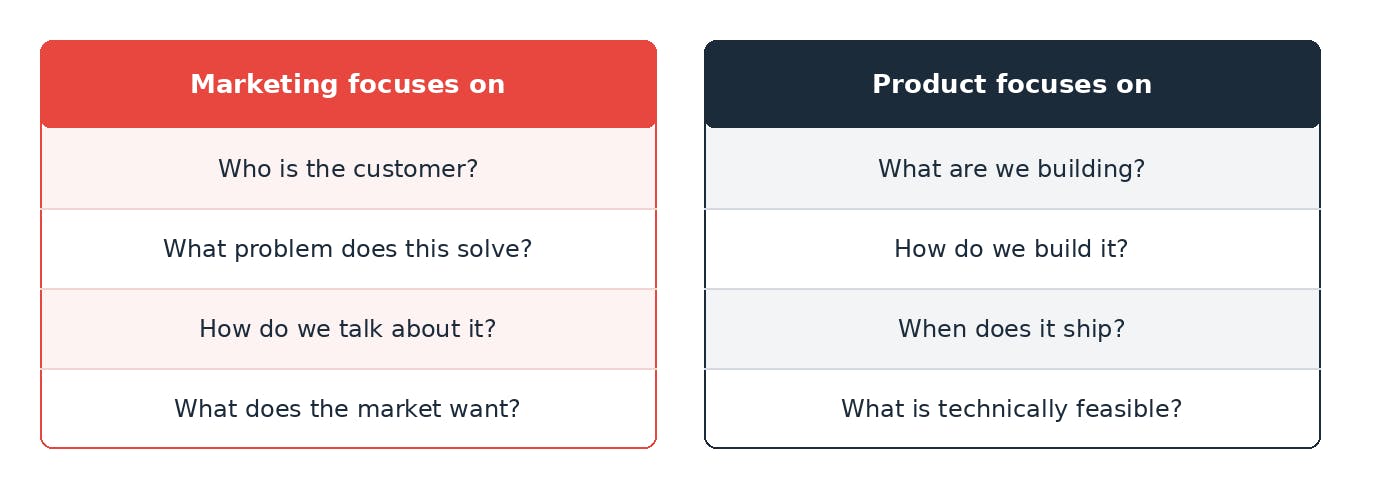
Product teams are naturally oriented toward what's being built: user stories, technical constraints, sprint cycles, roadmaps. Marketing teams are oriented toward how it's communicated: audience needs, competitive positioning, messaging, demand generation. Both orientations are valid. Both are necessary. But without a deliberate connection between them, these two worlds can operate on completely different timelines, with completely different vocabularies.
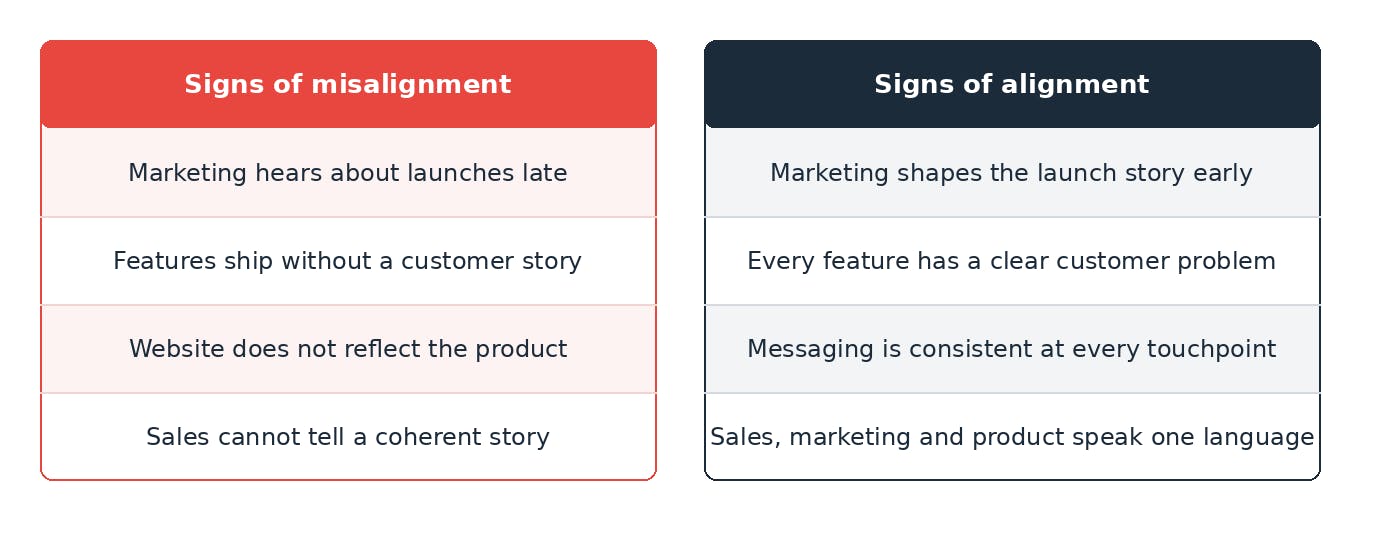
The drift usually shows up in one of four ways:
- Marketing learns about feature launches too late to plan a meaningful campaign.
- Product builds features based on internal assumptions, not validated customer language.
- The website or content doesn't reflect actual product capabilities or direction.
- Sales is caught between the two, unsure what story to tell.
Each of these points back to the same root cause: the two teams aren't sharing information early enough, consistently enough, or in a format that's useful to both sides.
The Marketing Perspective Product Teams Often Miss
Here's something I've noticed consistently: product teams often underestimate how much marketing knows about customers.
Marketers live in the voice-of-customer space. We read the reviews, monitor social conversations, run the surveys, analyze the conversion data, and test the messages. We know which pain points make people stop scrolling. We know the exact words a customer uses when describing a problem your product solves, and those words are often very different from the internal terms your engineering team uses.
When I worked with colleagues who genuinely invited that perspective into product conversations, things clicked. Features got named in ways that made sense to users. Launch messaging was ready from day one. Customer-facing documentation actually connected the feature to the problem it solved.
That's the opportunity most SaaS companies are leaving on the table.
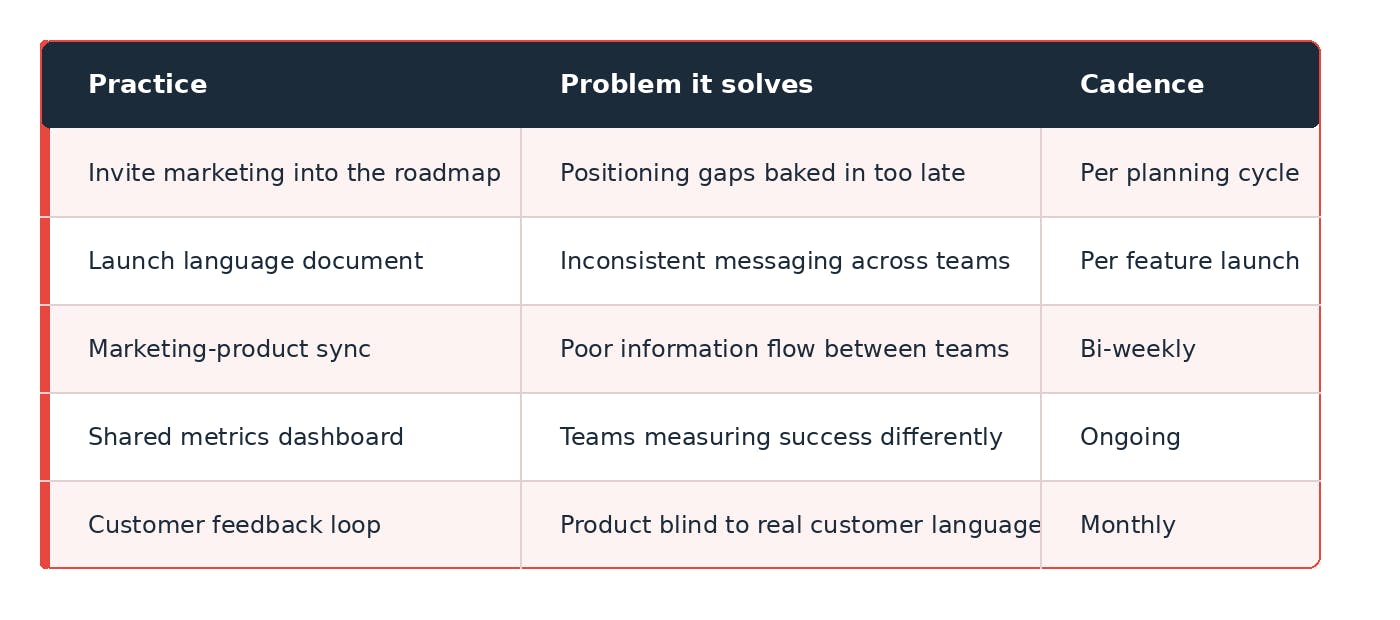
5 Practical Ways to Build Real Alignment
I'm not a fan of frameworks that look good on a whiteboard and collect dust in practice. These are approaches I've seen work in real teams.
1. Invite Marketing Into the Product Roadmap Early
Not at the launch meeting. Not when the feature is code-complete. Early, when priorities are still being shaped.
When a marketing professional is in the room during roadmap discussions, they can flag positioning challenges before they're baked in. They can share which customer segments are actively asking for a given capability. They can help the product team understand competitive context: what are rivals already communicating? What space exists that we could own?
This doesn't hand marketing the keys to the roadmap. It means the roadmap gets built with full awareness of the market it serves. That's a different thing entirely.
2. Create a Shared Launch Language Document
Every feature launch should begin with a simple shared document that answers three questions:
- What customer problem does this solve? (In customer language, not engineering language.)
- Who is the primary user who will feel this benefit?
- What's the one-sentence story we want customers to tell about this feature?
This becomes the shared foundation for everything: release notes, blog post, social content, sales enablement deck, in-app tooltips. When everyone starts from the same story, the messaging stays coherent across every touchpoint.
One document. Three questions. It sounds almost too simple. But most teams skip it, then spend weeks trying to reverse-engineer their messaging after the fact.
3. Set Up a Regular Marketing-Product Sync and Actually Protect It
A bi-weekly 30-minute sync between the marketing lead and the product lead can change a lot. The goal isn't a status report. It's a real conversation about what's coming, what's shipping, what customers are saying, and where the friction points are.
In my experience, these meetings produce the best ideas. Marketing brings field intelligence: what prospects are asking, what objections come up in sales conversations, what content is resonating. Product brings direction: what the team is building toward, what constraints exist, what trade-offs are on the table.
The tricky part is protecting this time. It's usually the first thing cancelled when sprints get intense. That's precisely when it matters most.
4. Build a Shared Metrics Language
One of the quieter sources of misalignment is that marketing and product often measure success differently.
Product might celebrate a feature's adoption rate. Marketing might be tracking trial signups from that feature's announcement. Neither metric tells the full story on its own. Put them together and they do.
For SaaS companies, I'd suggest building a shared dashboard that connects product usage data with marketing performance data. When you can see that a specific campaign drove signups who then adopted Feature X at a much higher rate, you've found something worth paying attention to. That's the kind of insight that shapes both the next campaign and the next product investment.
The goal is a shared definition of what "good" looks like, so both teams move in the same direction.
5. Let Customer Feedback Flow Both Ways
Marketing sits on a lot of customer feedback: NPS surveys, review platforms, social comments, support tickets, sales call recordings. Product teams rarely have full visibility into this data, and when they do, it's often filtered or delayed.
Creating a lightweight system to route relevant customer signals to the product team regularly is one of the highest-value things a marketer can do. A monthly digest of "here's what customers are actually saying" in their own words is often more useful to a product manager than a strategy document.
It goes both ways. When product teams share early concepts with marketing before they're built, marketing can act as a customer proxy: asking the questions a real user would ask, flagging language that doesn't land, spotting the moments that need better copy.
What Good Alignment Actually Feels Like
I've been lucky to work with people who modeled what genuine cross-functional collaboration looks like. The colleagues who left the most lasting impression on my career were the ones who understood their job wasn't only to deliver on their own team's goals. It was to make the whole organization smarter.
When alignment is working, you feel it. Feature launches have a story from day one. The team has a shared sense of who they're building for. Marketing can speak credibly about the product because they actually understand it. Product can speak credibly about the market because they've been listening.
And customers feel it too. The message they see in an ad matches what the product actually does. The sales conversation matches the onboarding experience. Trust builds.
A Note for SaaS Founders and CTOs
If you're a founder or technical leader, you have more influence over this than you might think, regardless of company size.
In early-stage companies, the culture of how teams work together is set by the founding team's behavior. If technical leaders actively invite marketing into product conversations because they genuinely value that perspective, that culture becomes the norm over time.
In growth-stage companies, the risk is that teams get larger and more specialized while the bridges between them quietly get weaker. The practices above become more important as you scale, not less.
You don't need to wait for misalignment to become visible before acting on it. The right time to build these habits is before you need them.
Before You Close This Tab...
Good alignment between marketing and product isn't about eliminating healthy tension. Both teams should push each other. Product toward market reality. Marketing toward product credibility. That tension, handled well, is where SaaS companies find their edge.
What you want to avoid is the silent drift: launches that happen without a story, features that ship without a customer insight, campaigns built on assumptions.
Start with one sync meeting. Create one shared launch document. Open one channel for customer feedback to flow between teams. Small, consistent habits add up.
And if you're curious about how any of this applies to your specific team, our team is happy to talk through it.