Jevons Paradox AI: Why Companies Are Hiring More Developers, Not Fewer
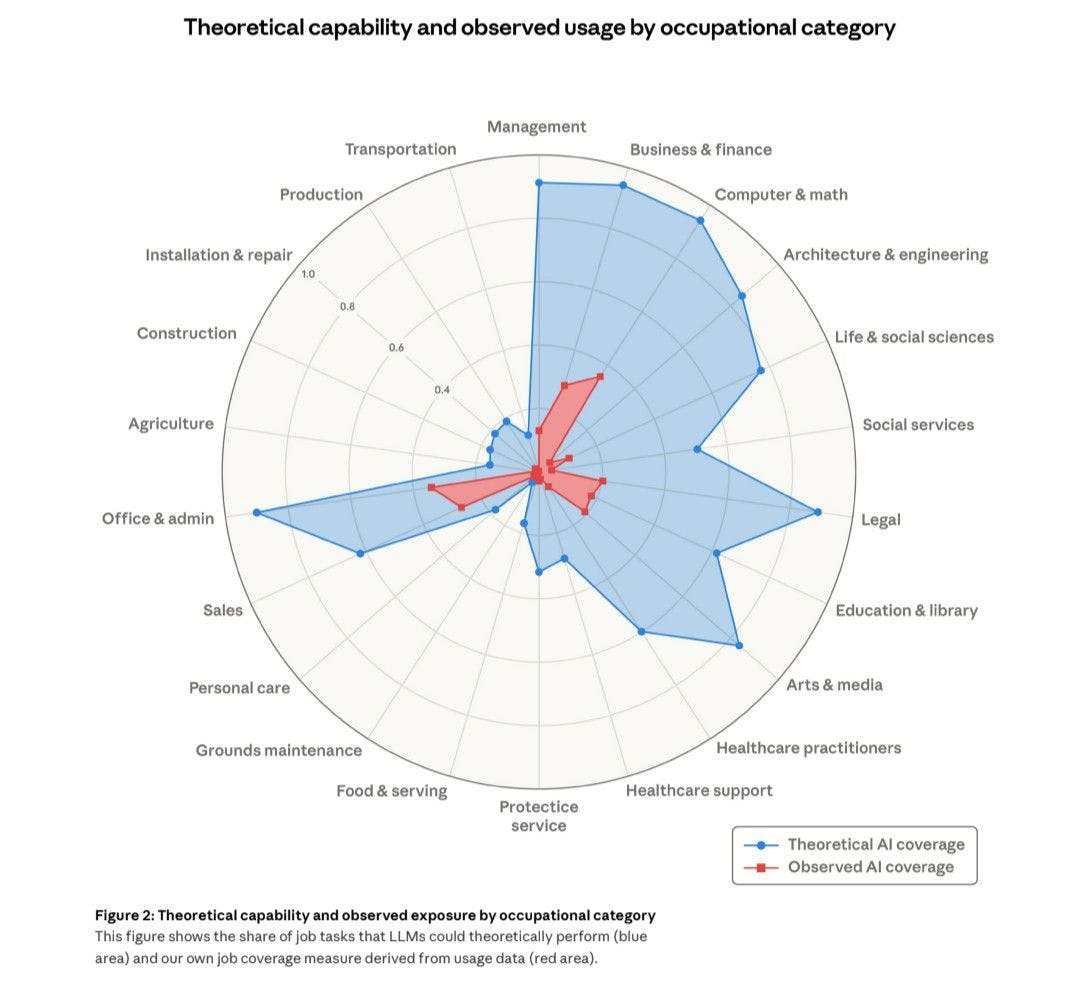
Everyone saw that radar chart from Anthropic, right?
A year ago, the narrative was everywhere: AI would replace developers. Junior engineers would be obsolete. Teams would shrink. The industry braced for disruption.
Then something unexpected happened.
Companies started hiring more developers, not fewer. This counterintuitive reality is explained by a 160-year-old economic principle called the Jevons Paradox—and it’s reshaping how we understand AI’s impact on software development jobs.
What Is the Jevons Paradox in AI?
In 1865, British economist William Stanley Jevons observed something counterintuitive. When James Watt’s steam engine made coal burning dramatically more efficient, coal consumption didn’t drop—it exploded. Cheaper, more efficient coal meant factories could do more with it, so they built more factories and burned more coal.
Efficiency didn’t reduce demand. It unlocked it.
The same pattern is now playing out with AI and software development. When AI tools make coding faster and cheaper, the total demand for software—and the developers who build it—actually increases.
The Data: AI Is Creating Developer Jobs, Not Eliminating Them
The fear that AI is replacing developers doesn’t match the data. Here’s what the numbers actually show:
• The U.S. Bureau of Labor Statistics projects software developer employment will grow 15% from 2024 to 2034—five times faster than the average for all occupations. That’s 287,900 new jobs and about 129,200 openings per year.
• Morgan Stanley Research estimates the software development market will grow at 20% annually, rising from $24 billion in 2024 to $61 billion by 2029. Their analysis is blunt: “Contrary to current market concerns that AI will replace human developers, we believe it will enhance productivity and lead to more hiring.”
• AI Engineer roles are up 143% since 2024. Job listings mentioning AI skills surged 56% in 2025 alone.
This isn’t what displacement looks like. This is the Jevons Paradox in action.
Why AI Creates More Demand for Developers
Here’s what we’re seeing in practice: AI doesn’t eliminate software—it makes building software cheaper and faster. And when something gets cheaper and faster, people want more of it.
Every AI feature a company ships creates new infrastructure needs:
• Microservices to orchestrate model calls
• Data pipelines to feed and monitor those models
• Evaluation frameworks to measure performance
• Moderation layers to catch edge cases
• Compliance tools to ensure safety and fairness
One of our recent clients—a top-3 global company in their industry (we can’t disclose the name yet)—came to us specifically because AI unlocked a product category they couldn’t build before. They didn’t come asking us to replace their developers. They came asking us to help them hire more.
The product they wanted to build requires real-time data processing, LLM orchestration, custom training pipelines, and integration into legacy systems that were never designed for this. That’s not a job you hand to ChatGPT. That’s a job that requires experienced engineers who know how to build, scale, and maintain complex systems.
This is a direct example of how the AI impact on software development jobs is expansion, not contraction.
AI Replaces Tasks, Not Jobs
Developers using tools like GitHub Copilot report productivity gains up to 55%. Junior developers write less boilerplate. Senior developers ship features 3x faster.
But faster doesn’t mean fewer people. It means more ambition.
The product roadmap that would have taken two years now takes eight months. The feature backlog that seemed impossible suddenly feels achievable. The ideas that were shelved for “someday” get prioritized.
This is the Jevons Paradox at work. When development gets more efficient, companies don’t shrink their teams—they expand their vision.
The Real Risk Isn’t AI Replacing You
It’s refusing to use it.
The market is bifurcating. Developers who treat AI as a tool are becoming force multipliers. Developers who see it as a threat are falling behind.
The companies hiring right now aren’t looking for people who can write boilerplate. They’re looking for people who can:
• Design systems
• Make architectural decisions
• Debug complex production issues
• Integrate AI into workflows that actually work
Those skills don’t get automated. They get more valuable.
What the Jevons Paradox Means for Software Development in 2025 and Beyond
Software is eating the world faster than ever—because AI made it cheaper to build.
More companies can afford custom software. More ideas become viable. More industries get digitized. More legacy systems need modernization. More AI models need production infrastructure.
All of that requires developers.
Not the same developers doing the same work. But more developers, doing more sophisticated work, building things that weren’t economically feasible before.
At BinarCode, we’re building with AI, not against it. Our team uses Copilot, Claude, and every other tool that makes us faster. Not because we’re trying to shrink—but because our clients’ ambitions keep growing, and we need every advantage to keep up.
How We’re Helping Companies Leverage the AI Paradox
We didn’t wait for the market to tell us what was coming. Over the past year, we’ve built dedicated AI service lines based on what our clients actually need:
AI Executive Assistants
Autonomous AI systems that handle scheduling, email triage, research, and decision support, so leadership teams can focus on what matters. Not chatbots. Real assistants that learn, remember, and act.
Custom AI Agent Development
Purpose-built AI agents integrated into existing business workflows. From sales automation to internal operations, these aren’t off-the-shelf tools. They’re built around how a specific company works.
MCP Server Development
We build Model Context Protocol (MCP) servers that connect AI systems to your data sources, tools, and infrastructure—turning AI from a standalone tool into an integrated part of your business operations.
All three exist because clients kept asking the same question: “We know AI can help us, but we don’t know how to build it into what we already have.”
That’s the gap. Not whether AI works—but who can make it work inside a real business, with real systems, real data, and real constraints.
The Bottom Line: The Jevons Paradox and Your Career
The future isn’t fewer developers. It’s developers who understand that efficiency unlocks demand.
The Jevons Paradox taught us that 160 years ago. We’re just seeing it play out in code.
If you’re a developer worried about AI taking your job, focus instead on how AI can make you 10x more valuable. If you’re a company trying to figure out whether to hire or wait, the data is clear: the companies investing in developer talent now—especially talent that knows how to work with AI—are the ones positioning themselves to win.
Frequently Asked Questions About the Jevons Paradox and AI
What is the Jevons Paradox in simple terms?
The Jevons Paradox states that when technology makes a resource more efficient to use, consumption of that resource often increases rather than decreases. In the context of AI and software development, as AI makes coding more efficient, the demand for software (and developers) increases.
Is AI really replacing developers in 2025?
No. Despite concerns, the U.S. Bureau of Labor Statistics projects 15% growth in software developer jobs from 2024 to 2034—far faster than average. AI is changing what developers do, but it’s creating more jobs, not eliminating them.
Why are companies hiring more developers if AI makes coding easier?
Because AI makes building software cheaper and faster, companies expand their product ambitions. Features that weren’t economically viable before become possible. This creates more work, not less—just different work focused on architecture, integration, and AI implementation.
What skills do developers need to stay relevant in the AI era?
Developers need to focus on skills AI can’t automate: system design, architectural decision-making, debugging complex production systems, understanding business context, and integrating AI tools into real-world workflows. Technical depth combined with AI tool proficiency is the winning combination.
How does the Jevons Paradox apply to other industries beyond software?
The Jevons Paradox has been observed in energy (more efficient engines → more travel), agriculture (better farming tech → more food production), and now knowledge work. When technology makes something cheaper or easier, total consumption tends to rise because new use cases become economically viable.
Sources:
• U.S. Bureau of Labor Statistics: Software Developers Occupational Outlook
• Morgan Stanley Research: AI in Software Development: Creating Jobs and Redefining Roles
• GitHub Copilot productivity research: Quantifying GitHub Copilot’s Impact

Author
Eduard Lupacescu
Leads BinarCode's vision and growth, with over 12 years building software products and teams. Focused on turning client challenges across Western Europe, the US, and Israel into reliable, business-driven engineering outcomes.